Wednesday, 16 November 2016

The Sabbatical Report: On being a citizen of this world


The opportunity to spend 50 nights in London came at a crossroads in my life. I thought it would be a kind of swansong, wrapping up my English research to focus on something closer to home: Australian archives, Australian themes, more easily achievable. That’s not going to happen. 


An archive at the end of a gravel driveway in Canberra does not have the same energy as an archive reached by way of the cobblestones of  the ancient Clare Market, and a 150 yard journey passing through five hundred years of history in bricks and stone, and half a million people.

 It is more than 50 years since I left London as a child. I thought it was symbolic to spend one night of Sabbatical here for every year I have been away. It would lay to rest the inexplicable yearning, because whichever side of the world I am on, I ache for the other side. I would be satiated.

I have observed this call of home in others and regarded it as misplaced ethnocentrism, as though something in the old world is intrinsically superior to the new. These, I thought, are the emotions of ungrateful and unsettled people. I am deeply attached to the Australian landscape and the seasons of the place where I live, its ancient culture. But it has taken a lifetime to discover all this. But then, although I don’t believe I am ethnocentric, I love London more now, than ever before. Not satiated.

Monday, 7 November 2016

The Sabbatical Report: Crouching women, trousered sisters and fractured memories


I closed my research on the theatrical agent Richard Warner with his death in 1914, by writing an academic paper that was published, done and dusted. I could not find a marriage for his daughter Miriam, and the most informative records are only released when they are 100 years old. I had originally intended to write a book on all of the Warners and their interminable retinue of relations: actors, agents, comedians, musicians, operatic singers, and some marvellous identities called Principal Boys in the Music Halls - we might think of them as cross-dressers today - but that idea was shelved.

But the whole topic of Warner Brothers came alive again after I met up with cousins in London (2C3R is the term – some of them are 3C4R – indicating how far removed they are from the mainline of my own family tree). Miriam lived on! Family branches tend to research their own interesting character and preserve their legend, which helps the big picture. Meeting  much removed cousins has been such a joy for me....and most informative!

Monday, 24 October 2016

The Sabbatical Report: Fighting friends


A very frank exchange of views: Fighting friends and the making of a productive scholarly culture

 Malinowski is regarded as the father of social anthropology, and he rates among the great thinkers of the 20th Century (all of whom had complicated Eastern European names).

Image result for malinowski
Malinowski
He is not my research subject, but I cannot ignore him. He was the intellectual son of the Seligmans - they were his benefactors, his mentors, encouragers, and they enabled him to take the first professorial chair in anthropology at the London School of Economics. He needed a wage and they didn’t.

All relationships of beneficence are fraught:  that was the important lesson of colonialism. and it demonstrates how charity disempowers. Entitlement lives alongside resentment, the desire for independence, to do it alone, and an unwillingness to recognise that someone else – parental figures – are enablers. Anyway, Malinowski’s relationship with his doctoral supervisor Dr Charles Gabriel Seligman (known to everyone as Sligs)  and Brenda Seligman, the woman who had the big bank account, was uniquely angst driven. He lived in their house, eat at their table, and he could be their harshest critic.

Monday, 17 October 2016

Early morning rain in Drury Lane

It is 7am and raining in Drury Lane, in the centre of Covent Garden, and the only disturbing sound is the long beeps of a truck reversing into the back of the Irish Pub. I did hear the Irish Pub sending its customers home as I was dozing off last night, but a fifth floor apartment with triple glazing is good insulation against the frantic bustling world of Central London.

Tuesday, 6 September 2016

Simon Winchester, narrative non-fiction - telling the back-story


Simon Winchester writes the most compelling history. I’ve just listened to two books he produced out of one research project – The Professor and the Madman;  The Meaning of Everything


Both books are about the making of the Oxford English Dictionary (OED) and they are not his latest work.  Sounds dull? I devoured the stories.  What is compelling about crusty scholarly hermits, mostly male, all old, beavering away on A-is-for Alphabet?  It’s their back stories, the depth of detail, the curious, eccentric, unbelievable intimacies of the tale. No character is without complexity.

 The archival work Winchester undertook would have been mammoth because the OED took decades to evolve and produced millions of scraps of paper from thousands of collaborators throughout the world.  The making of the OED was a long, laborious project that produced something like 15 discrete volumes of the OED – most of us have the little blue version that we had to buy for High School (back in the day…) One of the big problems for the original editors was whether the dictionary would ever make enough money to justify the £40,000 invested in it. Today I’m sure the Oxford University Press is doing nicely -  it’s available online by subscription, and there are many specialist dictionaries, some of which I own, and others that I covet.

The reason I listened to these books is because I have always liked the way Winchester tells history, and I am confident he has millions more readers than the average academic who plods through every dense sentence providing references and attributions and citations ad nauseam. Certainly fiction writers depend on our research for the historical accuracy of their stories, but Winchester captures the spirit of fiction in his facts.

Wednesday, 24 August 2016

Uncluttering my antiquities into the digital age


I decided to devote this week to digitizing.

 I’m never actually disorganised – I can usually locate a single volume amidst 3000+ books and I know what is in my three filing  cabinets – but in a digital age, is all this paper really necessary? 
Sometimes just the sheer volume of paper is overwhelming, and I revisit notes, trawling through my scratchings  instead of moving on confident that I have already captured some essence.
I have been building a digital system for several years, but not in a sustained way  –  this week I think I crossed the Rubicon. An academic entrenched in the past does not need to live in that forest of paper trails.

I’m not sure who will be interested in reading this blog, because you may not have the massive volume of data to cope with. But uncluttering is becoming an art form – there are personal trainers in the field. While Marie Kondo and the other Japanese experts are dealing with designer wardrobes, I have books, journal articles, notebooks, archival documents such as newspaper clippings, wills, company data, census data, etc…by the ton.  Getting bits of paper organized is worth the effort, and I thank the other bloggers who have helped me on my way.
http://www.elizabethcovart.com/work-flow-organize-research-writing/
 https://www.goodreads.com/work/quotes/41711738 

Wednesday, 17 August 2016

Gall, Wormwood and the Jewish mother


There may be Jewish Feminists but they do not represent Jewry. Feminism will never cross the Jewish threshold. It is gall and wormwood to the Jewish mother. Percy Cohen  (1904) Jews and feminism, The Westminster Review (October, p462)

The old motherhood statements are probably worth examining. They popped up again after Brexit, when the quantity of a woman’s progeny was touted as a quality for the new PM. I am a bit of an expert on this subject, in fact, by some standards I am a top candidate for British Prime Minister as I am currently bringing up my ninth (and absolutely final child…although I have said that on two previous occasions), That is a lot of kids by any standard.
 Please bear in mind that the majority were accidental, non-biological, and some were shorter term than others, but for most of my adult I have been cooking and cleaning up after 2-5 kids – the current ones are aged 17 and 25 so not children – living in my house.

Sunday, 7 August 2016

Sabbatical Report. Zangwill The Jewish Dickens and feminist.

There were some men who set out to empower women, whether it was their daughters, wives or friends.  Israel Zangwill is one of them. His name never gets a knowing nod these days. But he had an unforgettable profile, and a  long lean shape, perfect for caricature.


 Pacifist, Zionist, author, he was a convinced feminist at the fin-de-siecle, but his endorsement of feminist causes was not merely a polite nod to emerging ideas. He did everything with consuming commitment. It cost him his reputation and respectability in some circles.
Meri-Jane Rochelson has written a meticulous account of Zangwill's journey into women's suffrage in Jewish Culture and History (1999) and she is the avowed expert on Zangwill himself. Her book devoted to the man came out in 2010: Zangwill, a Jew in the Public Arena.

Wednesday, 3 August 2016

The Sabbatical Report - Speaking up


Cherishing illusory notions – they talk about emancipation when all they mean…is that women should…neglect her special functions in order to undertake responsibilities foreign to her whole nature (1904, Cohen, P. Jews and Feminism, The Westminster Review)

Speaking up most unnaturally


Research is a lot like knitting – you get so absorbed in the colourful threads that are coming together that you hardly realise it has taken on a life of its own.
At least, that’s how I knit and do research. The last jumper I made for my son Gabe is now being unraveled and re knitted because it was just too, too big. Many other people are far more disciplined. They learned to color within the lines, or make sure their swatches are accurate!

Please note that in the first two paragraphs I have managed to refer to domestic matters, because I do not want to be regarded as unnatural by Percy Cohen (quoted above). Here comes the emancipated female academic talking about her research…

Tuesday, 12 July 2016

The Sabbatical Report - Feathers


 My research during the next six months is for a book I am writing with a working title of "Feathers". The word is significant because all of the women I am writing about had feathered nests, in other words, enough money to allow them to pursue the things that interested them. These were women who lived in the late 19th and early 20th century whose families allowed and encouraged their intellectual work. They worked alongside men, sometimes husbands but often not,  and ultimately their names were associated with some of the greatest minds of the 20th Century, such as Einstein, Wittgenstein, Malinowski, and lesser known but important reforming intellectuals such as Cornford and Popper.
Court Leys, Oxford, the home of Brenda Seligman whose independent wealth  funded some of the earliest anthropological work in Papua-New Guinea and Australia. She grew iris here and entertained Malinowski.
 Doing this kind of research straightens out my thinking, because like most people I have absorbed Downton Abbey as a kind of arbiter of all things early 20th Century England. Few people lived like that, and although my research subjects had lovely homes and a few servants, they were middle class people without aspirations relating to money and class. Some of them had inherited enough from the Salaman ostrich feather fortune (feathers again!) to never need to worry about work, but they chose to work very hard and made significant contributions to their communities and the academies. None of them lived the lives of the rich and famous. The Salamans were smart with money, and knowing ostrich feathers might go the way of Dutch tulips, they had a huge property investment portfolio in London, which kept about 40 descendants in groceries for more than 50 years.

Tuesday, 5 January 2016

California Lilac, a weed needing the right rotten spot

A wonderful sea of weeds in a good marriage of colour and shape

Weeds, by definition, are vigorous. They spread, flourish, self seed, and that is precisely why we have a negative perception of them. Then we go out and buy exotic things that are not vigorous or hardy, that are attention seeking, sniveling shriveled up things that will not co operate.  I have decided that it is easier to change my perception of some of the weeds in my garden, that try to coax along the exotics in such dry reactive clay.

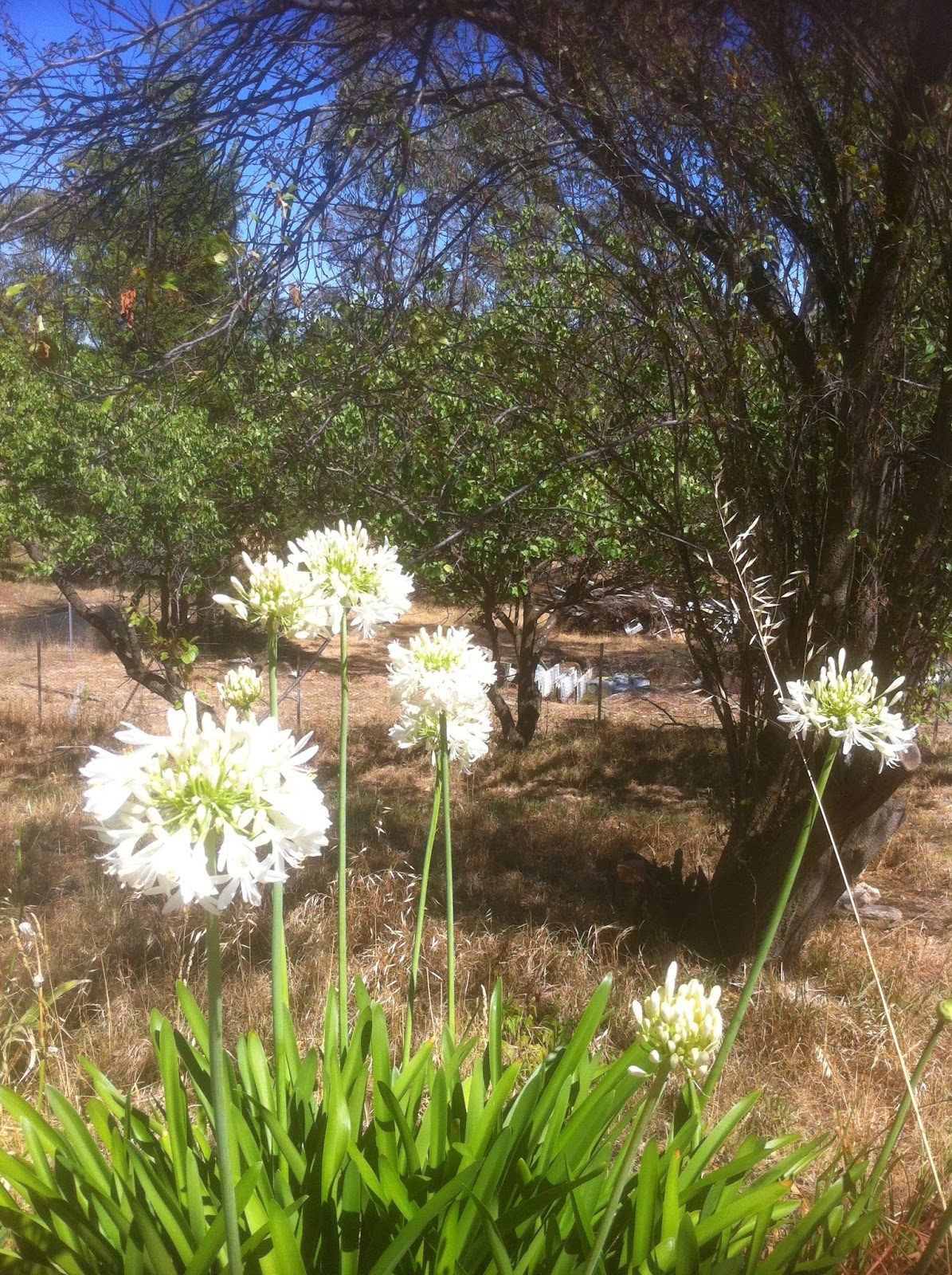
I have written about the elegant, shimmering sea of Agapanthus that rise up along my borders every Christmas. Regardless of the purists and town councils that want to eradicate sweet Agapanthus, she deserves a place to flourish and bless us with her brilliant seed heads every summer. She will grow where other things will not - rotten spots.

This summer I would like to pay homage to the California Lilac (Ceanothus) who thrives in hot dry spaces. She survives on poor clay soils, shooting out her angular shiny dark green foliage, rapidly expanding, and blessing the horizon with shafts of flower heads. In the picture above the California Lilac is the second row of blue at the back, behind the common lilac.

Saturday, 25 January 2014

Digging up the dirt on what's in my garden

 This big disc of iron has cast into it the name of John Bellamy, Byng Street, London.  It is a proud announcement that it is a valuable and significant item.

I included this photo in my last blog because the artefact has just been returned to the garden, this time on display rather than buried.

It is now a piece of landscape memorabilia, and I prefer the fact that it's more than a store-bought bit of rustica.

I wondered briefly if this thing had history, and when I finally sat down with a cup of tea after hours in the garden, I realised I needed to know more about Mr Bellamy's iron works.

I have an entire rust gallery of found items, mostly mechanical curiosities or farm equipment. This house had been in the same family for more than 70 years when we came, and nothing seems to have ever left the property. With no rubbish service, everything was buried.

When I tapped the Bellamy information into Google I was rewarded with a  history of the iron foundry company from 1860 to 1937, as well as half a dozen other interesting sites. Bits of iron like this are actually a valued curiosity for particular people who collect iron lids, and academic papers have been written about them, mentioning John Bellamy and listing other manufacturers of ship's tank lids Link: Shipping tanks

Here is an extract from Michael Pearson's paper in Australian Historical Archaeology.
"The ship tank was invented by Richard Trevithick, the prominent Cornish engineer of the industrial revolution, and his partner John Dickinson, in 1808. Their patent specifications of 31 October 1808 described well the advantages of developing the new container, which was the first to challenge the wooden barrel in its particular uses. The new ship tank was described as being for:
... the purpose of containing, enveloping,
preserving and securing from damage the several
articles of merchandise and other goods, whetherin
the solid or in the liquid form, which are taken on
board ships and other vessels to be transported or
consumed... And further, we do make our said
packages, vessels or receptacles of such figures or
forms that they fit exteriorly to each other,"

Today we would simply call these shipping containers.

Once I knew what the iron lid was, I realised that it probably fits into the  massive cast iron tank that I can see from my kitchen window, rusting away next door at the derelict school.  It probably arrived here in the early 1870's. According to one author, shipping tanks were abandoned on gold mining sites all over Australia and New Zealand, and re purposed as water tanks, dog kennels and domestic  storage containers. Below is an example of a lid in situ, made by another company.

A web site has been dedicated to the study of tank lids
Link: .http://www.ozwrenches.com/tank-lids-london.htm


A gardener's strategies for surviving another Australian summer

I spent several hours in the garden this morning, amazed at how much has survived our second relentless hot and dry summer in Cow Flat.

Dominating one of the embankments is a thriving golden diosma, that most pedestrian of little plants, useful if you want to fill a space or create a hedge. This one was given to me as a gift when I moved in, and given my personal plant prejudices, I tucked it between a collection of more interesting things, all of which have now died. I did not particularly nurture that plant, and each time I spotted it growing wildly, I wondered why. I guessed it just liked being here. This year I bought a couple more. There is wisdom in here, somewhere.

Everything is under a blanket of heavy mulch, but acclimatized plants push through with great determination. When the hot weather set in I decided to dig up a few plants - notably the passionfruit pictured above-  that were struggling and put them in my Mercy Garden close to the house, where I could water them with whatever we saved from the shower and washing machine.

Sunday, 5 January 2014

In praise of the humble but hardy Agapanthus

Everything in the garden is crisp. It has been the hottest summer of the hottest year on record. Yet the humble Agapanthus is blooming in long avenues throughout my garden, and I  so very grateful for its hardiness. 

We gave away thousands of these plants after the Bob Cat dug up a hundred years' growth through the old orchards, but we judiciously replanted the long rows along the driveway and towards the back paddocks.

Everything else I impulsively planted before going into hospital in October, is dead. Even things that have survived here for decades are shedding their branches. There is a massive cedar in one corner which is probably as old as this house (1879) and it is throwing away branches in disgust, determined to survive.

Saturday, 24 August 2013

One week of winter


I picked a large daffodil for the kitchen windowsill this morning to ponder while I emptied the box of Uncle Toby's oats.

That large lone daffodil was magnificent in the midst of swathes of lemony little jonquils that have emerged from the path cut by the Bob Cat. The jonquils had been suppressed by the 100 year old shrubbery that we ripped out.

 The daffodil and all its promise of spring was more lovely as it stood with me looking out at the cold misty morning from the warmth of the kitchen as I breakfasted for the last time this year on oats (a superfood we're told, that reduces cholesterol if eaten in sufficient abundance) with skim milk (to preserve the slender form) and honey (to reduce inflammation of the joints). The oats have expired along with winter, and spring holds better promises.
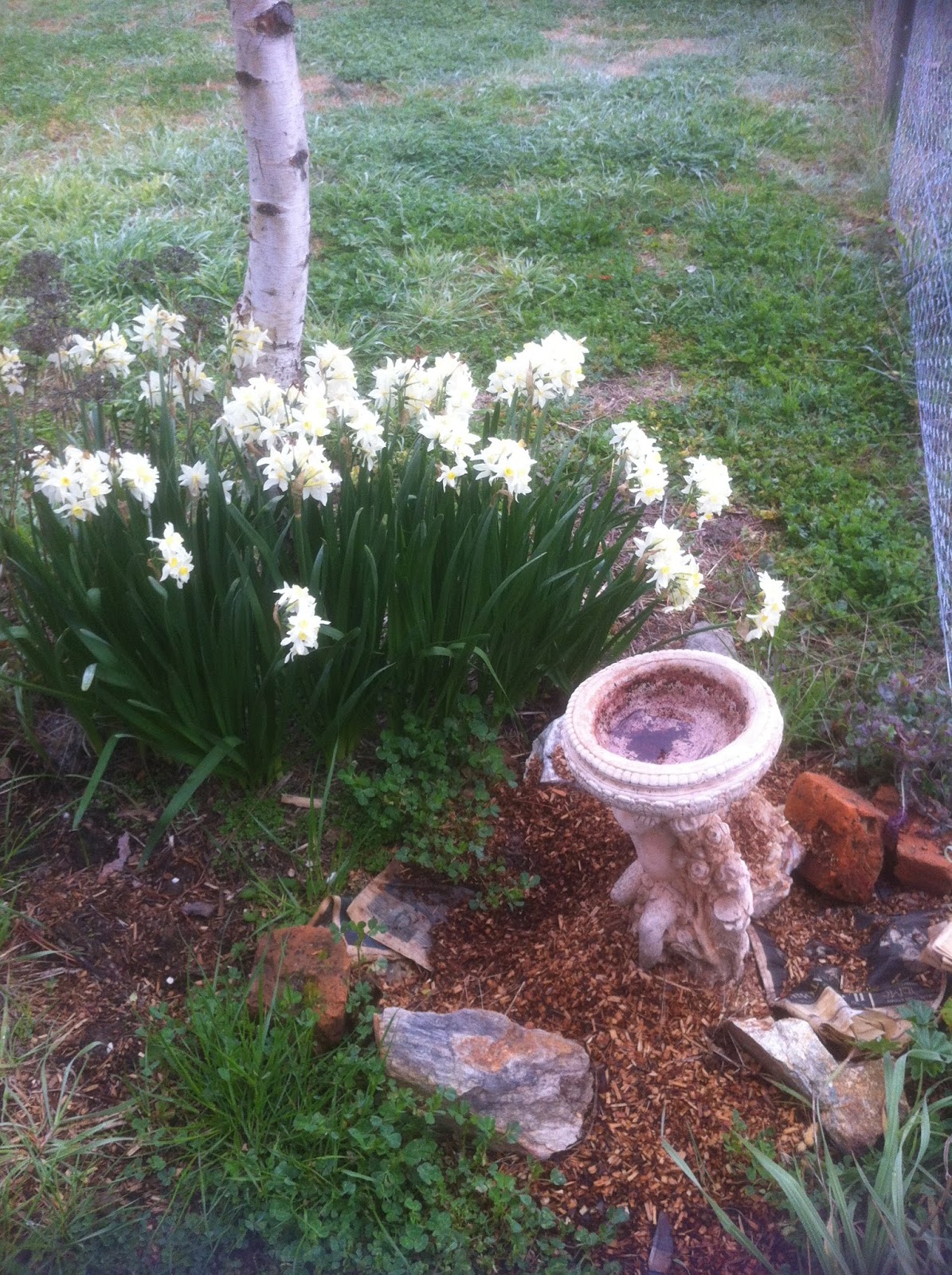


Beyond the kitchen window the Japonica something is blossoming a scarlet tinged pink.In the picture above you can see it feintly. Still haven't bought my new camera. And I still haven't identified this so often leafless shrub which goes on to produce small quilted fruit like apples. Tasteless. I am just grateful we did yield to the Bob Cat operator's convenience. So many bulbs have popped back up, and some of the shrubs are returning warily.

Half a dozen gnarly old apples and plums remains as the centerpiece for our spring project, a meadow of self seeding annuals interspersed with salvias, daisies and a path of odd shaped stepping stones that I retrieved for $2 each the the Junktion (Tip Shop). Oh, and if the trees don't fruit, rambler roses will be grown over them.

I have not blogged since May. Reason (1) I have not been gardening much due to the continued degeneration of my Evil Knee (2) I suspended all deadlines, urgency and planning around the garden - it was meant to be a ten year project, and it hardly matters when it is"finished"  (because gardens are never finished).


But yesterday, with winter almost done, Juliet and I hobbled to the Growers Markets in Bathurst. Dwarfs have very little legs, so Juliet's walking capacity matches mine perfectly. We visited our two favourite growers, who are getting to know us: the Blue Wren native nursery which sell things in $4 tubes that are acclimatised to Cow Flat, and the cottage garden keepers who come in from 100km away, with big pots of established hardy perennials. Yesterday we also met a new fellow who lives locally and raises herbs. Next week Linda, my lovely gardener, comes back after her winter "holiday" (unpaid leave, sorry) to begin planting and cultivating our new projects.

To make some concessions to the Evil Knee (E.K.) my herbs will be moved up to small new beds right next to the house, where I can look after them....rather than down in the valley where the chickens can dig without my supervision. I am going to build a Medieval garden down in the valley and let it run wild - I have even bought those voracious nuisances Comfrey and Jerusalem artichoke to go populate the forgotten corners.I am thinking of a backdrop of another equally weedy item, the California Lilac, only because it attracts bees, and as long as they are way down in the valley land grabbing won't bother me  (it's really just a little slope, but it's the E.K. talking). Now I know these plants don't sound terribly Medieval, but in the midst of this will go to the Madder and Indigo, and all the other dye plants that I am trying to source.

Our solar power is going in within the next few weeks, and my next plan is to link a second water tank to my studio, to feed the Medieval garden and the vegetables. I state that baldly, knowing there will be no veg this year due to the next round of surgery on the E.K., and the studio exists only in my mind, and in the imagination of one of my Handy Men. The studio will be an"extension" of the Number 1 Dunny which has the best distance views back to the Central West. It will be built of the convict bricks, the ancient timbers we have retrieved, old stone, oak doors and the iron machinery parts from the rust gallery. This Handy Man has done some extraordinary retrievals of very old Bathurst buildings, and he loves to source beautiful original bits of stuff to do creative constructions.

So if I didn't work in the garden much this winter, what did I do (apart from teach 500 students, cook amazing food, sing in the choir, swim laps, chauffeur my granddaughter and write some articles for academic journals).....see below. I prepared Alpaca fleece for spinning and I spun, plied, knitted, weaved and crocheted away the long winter evenings. Thankfully it's my left knee that is exceedingly evil, leaving me the capacity to spin with the stronger right leg, which is also my driving leg (automatic  car, no left leg needed). Next year I'm hoping that my Alpaca  fleece will be spun by the end of winter and dyed from my Medieval garden. The colours will be more subtle than the commercial dyes.


Saturday, 4 May 2013

The felines of Far Out

When we came to Far Out I intended to have only two cats, Porgy and Bess. But no one wanted Tigger, so he stayed, and then, along came Daisy.

I gave up cats for about 12 years in the interests of small birds and wildlife, and also because I was afraid of becoming a cat lady. But when there was a plague of field mice, I went out in search of an effecive solution. The first candidate was a  $200 rescue cat from the  RSPCA with the most promising name of  Hunter, who was gorgeous looking but scratchy and not cuddlesome.. When I asked if he might decide to move out of our place,seeing as he had abandoned one family, the cat-keeper told me that they generally did run away, there was no refund, and if it was rescued again and rehoused I would have to pay up again!
Daisy the dwarfette


Porgy the kingpin

I decided to hunt for a careless Cat Lady who did not desex her animals. Such women always have  a A Bad Reputation in the Neighbourhood, so it did not take long source a  Genuine Cat Lady with around 68 cats all living inside her house.

 I brought home two  kittens (free to good home, of course), brother and sister, who had been hauled around remorselessly by the children of Genuine Cat Lady. They were black with fleas...the kittens, that  is ( I didn't check the children!)

Once my moggies (Porgy and Bess) were thoroughly Veterinated, they proved to be adorable. The male had the big chop immediately....and the girl got pregnant before reaching the mandatory weight for desexing. She chose the Russian Blue next door (can hardly believe that they were as careless as we were on that issue).  We accidentally kept the least attractive of the litter, Tigger, and he has proven to have the beautiful disposition of his relatives, calm and floppy, purry and peaceful.

Thursday, 2 May 2013

The Master Bricoleur arrives


I am always looking for skilled trades and craftspeople to help me with the house or garden at Far Out.


I did not have to wait long for a bush brickie to take down my 1879 dunny. A "free" laborer walked back into our lives in the shape of Son Number 3,  home from his unhappy marriage. 

 He doesn't want to be back home at 30 something, and I don't want to keep him, but it's bed and board and a fair exchange because work is his way of handling the angst.

Who can blame a man for longing to be with his children and to have his own home and life  as it once was. In less than three months Son Number 3 has demolished the dunny, cleaned the bricks, formed up the paths and laid most of them, built concrete steps, ripped down a wall of vegetation that obstructed the paths and views, chopped wood for the winter, fixed doors that were unhinged or stuck, repaired my wooden bobbins, created shelves in a cupboard for our video collection, and motivated his aging father to participate in some of  these non sedentary activities. He has also been on shopping sprees to our local recyclers next to the tip, and entered into the values of the bricoleur,  the craftsman who wastes nothing, who remakes, restores and reuses.


 .So now the lovely dunny shown in the picture above has gone into the magnificent path on the left....all those diamonds on the bricks indicate convict labor from around 1870. The second dunny is nothing more than a deep double brick pit....who knows what we can do with that?  The beautiful sandstone window ledge has been removed, and it is awaiting a new home. The louvered window was made of cedar, and it was still in pristine condition, and it will go into another building. The bricks have been cleaned and laid into the  path which ties the garden and house into a cohesive whole.

For those who think the demolition of this dunny was sacrilege, don't worry, we have two more precisely the same.  The one nearest the house will be restored into a working flushable lavatory, and the one farthest away will be extended into a studio that looks out to the distant hills. I want a studio for my Indigo dye baths, and the floor loom I am planning to buy. When I write things like this I wonder if it is actually achievable, but when I look around the place at Far Out and see what has been done in just over a year, I feel confident.


On the left is one of the two surviving Dunnies...this one has a kerosene can roof. The path will wind down past it to join up with the long straight one which goes to the veggies, the chook and what will be a citrus orchard with protection against the bitter winter.

Bit of sandstone on the ground at the bottom left of the picture.


I cannot imagine why the washing line (picture below) was put at the top of this slope - sure, it catches the breeze, but for someone with Evil Knees it is quite a struggle. Steps will be a help.


.

Friday, 1 March 2013

Autumn is coming up with roses


Autumn has blown in early bringing abundant rain. The garden made a sudden recovery from the long hot summer, and the roses, which I had fed with something called Black Gold, burst into bloom. The long months of  mulching and buying in water, twice using the water and bucketing it out  to stressed plants, was rewarded. I even welcomed the purple and mauve  bracts of buddleia, not my favourite shrubs, but they survived and bloomed.  Despite my Evil Knee, depleted bank account and the weather, the garden is alive and flourishing.

I learned so much about resilience and perseverence from the garden.

The stone embankment we built eight months ago, using recycled blocks found in the paddock,  has ground cover roses tumbling down it, annuals, fuchsia, natives grevillia  and miniature agapanthus. Strange combinations which I have never attempted before. I am growing plants that are strangers to me, because I lived in the mountains for so long or in its shadow. This climate is bewildering.

Saturday, 19 January 2013

Resting the evil knees for six weeks

If you must spend extended periods resting Evil Knees, it is important to be able to gaze upon beautiful things.


No knees, no water, no grass, but we have fences

I had the surgery for my Evil Knee  in November. It is now Januaury, and although I can walk limited distances, stand for short periods of time, and even potter in the garden for an hour, I certainly cannot dig, carry or mow. There is an incessant ache in the knee, with intermittant bouts of pain so amazing that I have my own cupboard full of  drugs to die for (if you have any junkie inclinations).